 DeepSeek MLA latent cache
A third smaller than FP8. Up to 2.5× more accurate.
Serving stacks keep DeepSeek's latent cache at about 8 bits because int4 costs too much quality. weights.zip matches FP8 quality in 1.4 to 1.5× fewer bits at 100k context, and for sessions paged out to CPU memory or SSD it stores the cache in two thirds of FP8's bytes with 2.5× lower error.
int4 memory. Better than FP8 quality.
The cache is the memory that grows with every token of context. weights.zip stores it close to int4 size while beating today's FP8 format on accuracy, so every GPU holds more long-context users and every parked session costs less to keep.
Bits per cached value
DeepSeek-V2-Lite, 100k contextError relative to FP8 (lower is better)
Offloaded cache, 100k contextThe FP8 mix is what serving stacks use today: FP8 per token for the latent part of the cache and int8 for its position part, 8.06 bits per value. Deployments that keep the position part in bf16 use 8.92 bits per value, which makes the saving larger.
Capacity · a provider on 1,000 H100s serving a DeepSeek MLA model at 100k context, 10,000 concurrent users with the FP8 mixUsers served on the same 1,000 GPUs
Idle sessions parked in the same offload tier
With 2.5× lower error than FP8GPUs needed for the same 10,000 users
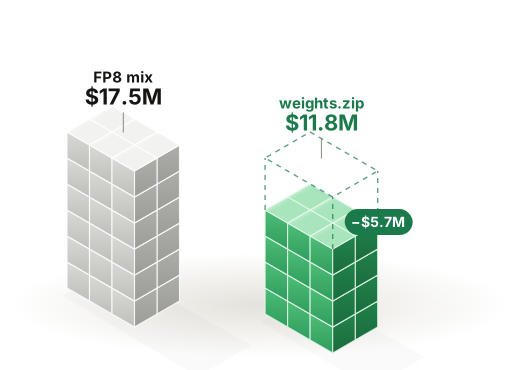
Annual GPU cost for the same users
| Cache format | H100 GPUs | Per year, reserved | Saving, reserved | Saving at on-demand rates |
|---|---|---|---|---|
| FP8 mix | 1,000 | ~$17.5M | baseline | baseline |
| weights.zip | 676 to 704 | ~$11.8M to $12.3M | ~$5.2M to $5.7M | ~$9.4M to $10.2M |
GPU figures use the GPU format at FP8 quality: 1.42× fewer bits on code and 1.48× on prose; charts use 1.48×. Where cache memory sets how many users each GPU serves, users scale with cache capacity, assuming decode runs at FP8 speed. Reserved H100 capacity at about $2.00 per hour ($17,500 per GPU-year); on-demand at about $3.61 per hour.
What you get
- About a third less cache memory than today's FP8 format, at FP8 quality or better.
- More concurrent long-context users on every GPU.
- Parked sessions in CPU memory or on SSD that are smaller and more accurate than FP8.
- No retraining and no changes to the model weights.
Good fit when
- You serve DeepSeek or other models with a latent attention cache.
- Cache memory limits how many users each GPU can serve.
- You page long chats and agent sessions out of GPU memory.
- int4 would save the memory but costs too much quality.
Verified live at 100k context against today's FP8 format.
Offloaded cache · 0.67× FP8's bytes| Test window | Error vs FP8 | Tokens where ours beats FP8 |
|---|---|---|
| Prose, window 1 | 0.32× | 81% |
| Prose, window 2 (never used for tuning) | 0.34× | 85% |
| Python code | 0.61× | 57% |
| All three | 0.41× (95% CI 0.36 to 0.47) | 57 to 85% |
5.43 bits per value against FP8's 8.06. Against int4, the format most often deployed at 4 bits, the error is 11 to 16× lower for 10% more bytes. Each window scores 1,024 tokens at 100k context, and the window marked was never used to choose any setting.
GPU cache formats · DeepSeek-V2-Lite, 100k context| Format | Bits per value | Quality |
|---|---|---|
| FP8 mix (today's practice) | 8.06 | baseline |
| int4 (group 64) with int8 position part | 4.92 | about 4× FP8's error |
| weights.zip | 4.97 | 3 to 5× lower error than int4 at the same size |
| weights.zip | 5.44 | level with FP8 on code, half FP8's error on prose |
| weights.zip | 6.31 | 2 to 6× lower error than FP8 |
Reproduced on a second GPU type (H100, 2026-10-13): the H100 rows match the L40 run configuration by configuration. At FP8 quality, weights.zip needs 1.42× fewer bits on code and at least 1.48× fewer on prose. Quality is KL divergence of the model's next-token predictions against the uncompressed model, on the live model in fp32. Every number was re-checked by an independent verifier, with sizes counted from the real stored bytes and the test text kept separate from any tuning data.
No retraining. No changes to the model.
- Prepared once per modelA one-time offline step per model. The model weights are untouched and nothing extra is stored per token.
- Swap the cache formatThe cache is written and read in the weights.zip format on the GPU, and in the higher-accuracy format when sessions are paged out.
- Pilot on your trafficWe integrate with your serving stack and measure memory, quality and capacity on your models and prompts.
Free benchmark on your models and traffic.
- Tell us your stackThe models you serve, your context lengths and your serving engine.
- Get your numbersMemory saved, quality against your current format and capacity per GPU, measured on your prompts.
- PilotRun on one workload for 30 days. Pricing is a share of the measured saving.
Built for the models you serve.
Model names and logos are trademarks of their owners and are used only to identify the models tested. weights.zip is not affiliated with or endorsed by DeepSeek, NVIDIA, Z.ai, Meta or MiniMax.